Every season, FarmOptima already records what's happening on thousands of smallholder plots — soil organic carbon, satellite NDVI, GPS boundaries, practice records. We built an engine that turns that same data into verified carbon credits, with no new burden on the farmer. Here's how it performed against a live 27-plot pilot in Assam.
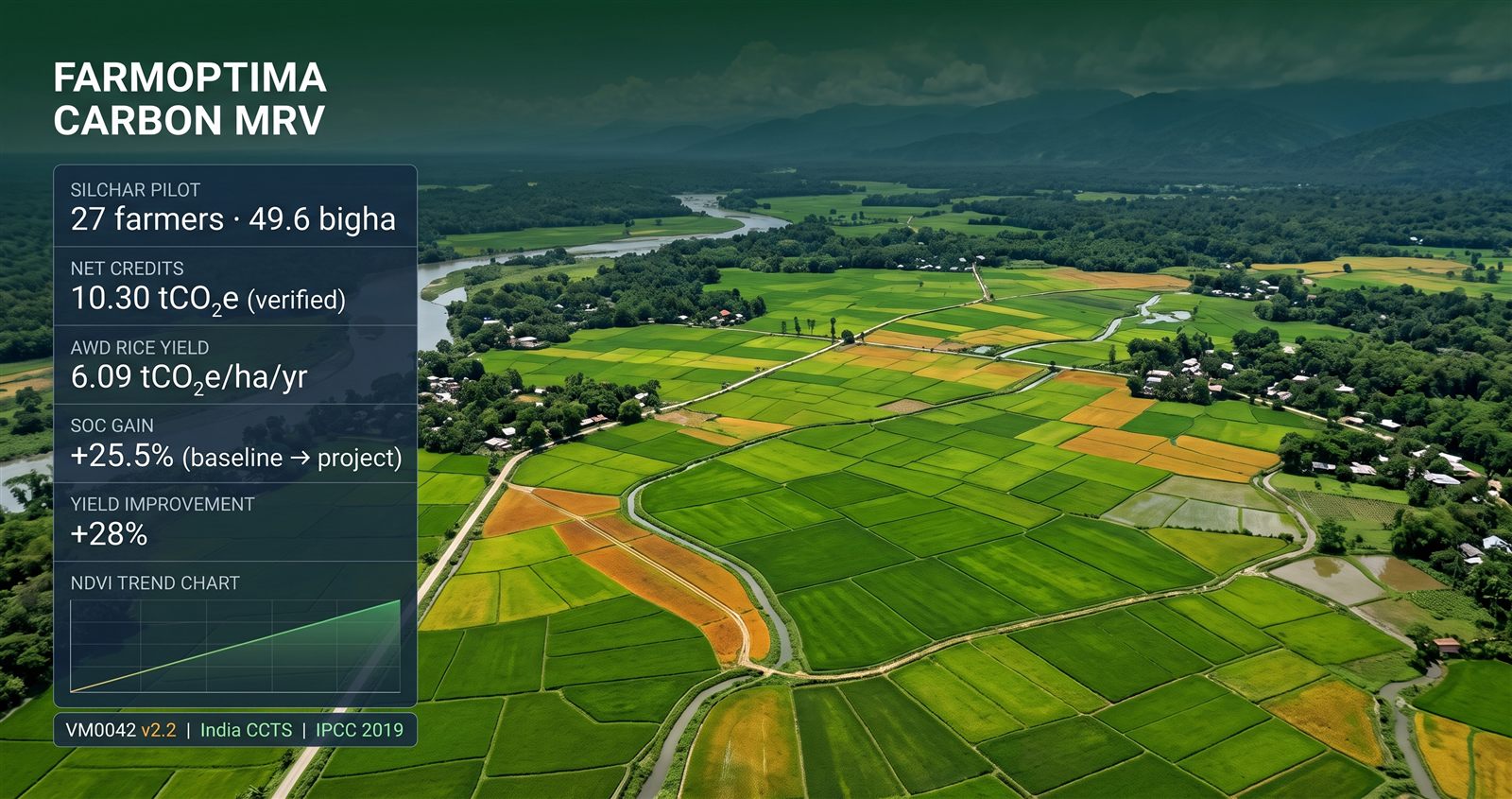
India's agriculture sector emits roughly 14% of national greenhouse gases, and practices like reduced tillage and legume rotation genuinely sequester soil carbon. The gap has always been measurement: how do you quantify carbon gains at the scale of a 2-bigha plot without pricing the farmer out of the market?
Carbon MRV has historically meant consultants, manual soil surveys, and spreadsheet-built project documents — a cost structure built for industrial projects, not a smallholder with half a hectare. That cost has kept the segment with the most restorative potential almost entirely outside carbon markets.
Two regulatory shifts landed in the same window. India's Carbon Credit Trading Scheme approved agriculture as a Phase 1 BEE offset sector. Verra's VM0042 v2.2 received ICVCM Core Carbon Principles approval in October 2025. Together they make smallholder soil carbon a methodology-backed, tradeable asset for the first time.
The soil OC readings that already feed advisory recommendations now also feed SOC stock calculations. The NDVI time-series that already track crop health now also serve as continuous biomass monitoring. The Agripreneur field visits that already verify practice adoption now double as carbon verification events. Every farmer who joins FarmOptima is automatically carbon-MRV-ready.
The system works as a five-layer pipeline built directly on FarmOptima's existing Agripreneur data infrastructure. Only one layer had to be built from nothing.
The engine doesn't report gross reductions. Every plot's number is cut by VM0042's own prescribed deductions before it's claimed as a credit — a 20% non-permanence buffer against future SOC reversal, and a 15% uncertainty deduction reflecting how wide Tier 1's default-factor error bars are by design. That's not a hedge against our own implementation error; it's the methodology's own conservatism, applied identically to every plot regardless of size.
| Factor | Baseline → Project |
|---|---|
| Tillage management (FMG) | 1.00 → 1.04 |
| Carbon input (FI) | 0.92 → 1.37 |
| Reference SOC, Assam LAC soils | 47 tC/ha |
| Metric | Value |
|---|---|
| Enrolled plots | 27 |
| Area | 6.64 ha (49.6 bigha) |
| Baseline SOC | 25.08 tC/ha |
| Net creditable volume | 10.30 tCO₂e |
VM0042 and India's CCTS can't both claim the same hectare, so farmer cohorts are assigned to one pathway or the other at enrollment — Verra VCS for international VCU credits, India CCTS for domestic CCC trading on CERC-regulated exchanges — based on geography and intervention type, not decided per calculation.
FarmOptima is building the carbon layer for smallholder agriculture on top of data you already collect. We'll walk you through how the same engine applies to your cohorts, your geography, and your registry pathway.